
Questions and answers
Bloodhound FAQ
Quick, honest answers to the questions people ask most often about bloodhounds.
In short: Quick answers: bloodhounds are large scent hounds, 58 to 69 cm tall and typically 36 to 50 kg, with a Kennel Club lifespan of under ten years. They drool, need more than two hours of exercise a day, are usually gentle with children and are not ideal for flats. This page answers sixteen common questions.
Last updated 23 October 2026
Your bloodhound questions answered
Here are sixteen of the most common questions we hear about bloodhounds, with short answers. Each links to a fuller guide where you can read more. If your question is not here, please ask us.
Quick facts: bloodhounds are large scent hounds, 58 to 69 cm tall, typically weighing 36 to 50 kg, with a lifespan the Kennel Club lists as under ten years. They are gentle, sociable and sensitive, and they need lots of sniffing exercise.
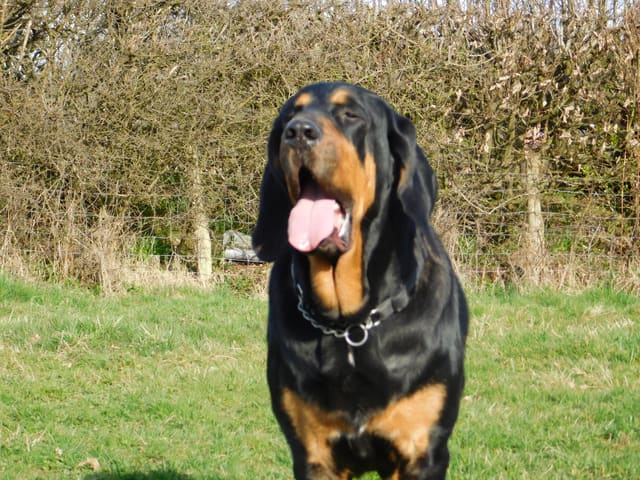
How big do bloodhounds get?
According to the Kennel Club, dogs typically stand 63 to 69 cm (25 to 27 inches) tall and bitches 58 to 63 cm (23 to 25 inches). Adults typically weigh around 36 to 50 kg.
How long do bloodhounds live?
The Kennel Club lists a lifespan of under ten years. Many bloodhounds live to around ten, and some a little more or less. Good care and regular vet checks help.
Do bloodhounds drool?
Yes. Their heavy jowls and loose skin mean that drool is part of life with a bloodhound, especially after eating and drinking. Keep a towel handy.
Are bloodhounds good with children?
Usually, yes. They are gentle and affectionate, but also large and strong, so always supervise interactions between a bloodhound and young children.
How much exercise does a bloodhound need?
The Kennel Club lists more than two hours a day. Much of this can be slow walking and sniffing, spread across the day.
Can bloodhounds be left alone?
Many do not like long periods alone. They are sociable dogs that can become unhappy, noisy or destructive if left for long. Build up alone time gradually, and plan care if you work long hours.
Are bloodhounds hard to train?
They are intelligent but independent and scent-driven. Patient, reward-based training works best, and recall can be the hardest lesson.
Why do bloodhounds have wrinkles?
The loose, wrinkled skin and long ears are part of the breed’s classic look, and are often said to help hold scent close to the nose. The folds need regular care.
Can a bloodhound live in a flat?
It is not ideal. These are large dogs that need space and a secure outdoor area. The Kennel Club suggests a large house with a large garden.
Do bloodhounds shed?
Yes, they do, but the coat is short and smooth and usually needs only a weekly brush.
Why are they called bloodhounds?
The name is usually said to recognise the breed’s pure, noble bloodlines, rather than anything to do with blood. Bloodhounds descend from the hounds of the monks of St Hubert, and were once called St Hubert hounds.
What colours are bloodhounds?
Black and tan, liver and tan, and red are the accepted colours in the breed standard.
What health problems do bloodhounds have?
Common concerns include bloat (GDV), ear infections, skin fold problems, eye problems and hip and elbow dysplasia. See our health page, and ask your vet.
Are bloodhounds rare?
The Kennel Club lists the bloodhound as a vulnerable native breed, with fewer puppies registered than for many other breeds.
Can a bloodhound travel by plane?
Sometimes, but it needs planning. Large dogs like bloodhounds usually travel in the hold of a commercial airline, or by private jet or charter with the dog in the cabin. What is possible depends on the airline or operator and on your dog’s size, so check with your vet and the carrier first. For more, read travelling with a bloodhound or Pet Friendly Flights: flying with large dogs.
How can I adopt a rescue bloodhound?
Contact Blood Hound Rescue UK, send back the prospective adoption form with a covering email and your telephone number, and we will talk it through.
Read more
Learn more in our breed information, health, training and living with a bloodhound guides, or see is a bloodhound right for you?
More bloodhound guides
Thinking of adopting a bloodhound?
We match every rescue hound with the home that suits them best. You are very welcome to talk it through with us first.